EPA Involvement
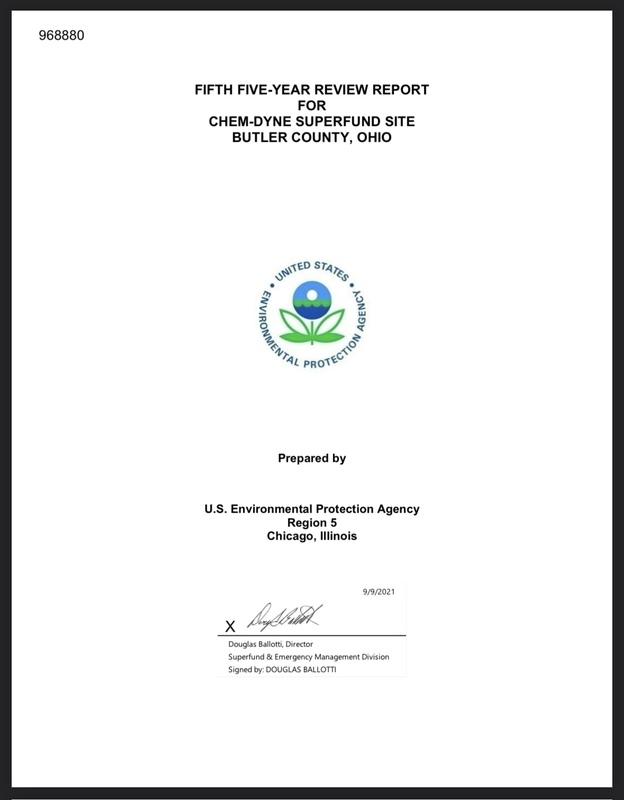
The Chem-Dyne Five Year Review: Key Takeaways
As part of the Superfund Site cleaning and monitoring process, the Environmental Protection Agency (EPA) conducts a Five-Year Review. The Five-Year Review for Chem-Dyne offers a history of pollution at the site, a review of how EPA intervention has mitigated existing biohazards, and an overview of what steps may be necessary to further protect this region. The most recent review was conducted in 2021, about fifty years after the Site had been adopted by the Chem-Dyne Corporation to process chemical waste.
While the Five-Year Review is ninety-seven pages, below are summaries of the key takeaways and questions answered by the EPA’s report, including an explanation of some of the scientific terms essential to understanding the factors that contribute to environmental injustice at Chem-Dyne.
What happened at the site?
Chem-Dyne is located at 500 Joe Nuxhall Boulevard in Hamilton, Ohio. Between 1974 and 1979, the Chem-Dyne Corporation purchased the Site to process and store over 112,000 drums of waste. The Chem-Dyne Corporation had dozens of corporate clients who sent their waste to them to have Chem-Dyne Corporation handle their waste.
When Chem-Dyne shut down in 1980, over 300,000 gallons of waste were left on-site in drums and tanks, some of which contained leaks. The leak in one railroad tank car led to the uncontrolled release of hazardous materials into the soil and groundwater of the surrounding area.
This caused Chem-Dyne to become the “worst environmental hazard in Ohio and one of the worst [Superfund sites] in the nation,” as one journalist reported in 1982.
Large fish populations were killed by environmental leaks, and locals suffered from the strong stench of chemical fumes. The long-term health effects of this pollution remain unknown.
In 1981, the leak became a part of the EPA’s National Priorities List. Through an investigation, the EPA determined that the Chem-Dyne Corporation’s pollutants had penetrated deep into the surrounding soil and groundwater/aquifers. The site had extensive contamination, and the 1984 Feasibility Study determined the following:
- The site was too dangerous for humans to make direct contact.
- The groundwater in the site was too dangerous for private well users to extract.
- The groundwater plume could cause the water downstream from the site to be dangerous to extract water from, causing health consequences for nearby residential communities.
What pollutants are in the area?
The waste gathered from different companies and processed by the Chem-Dyne Corporation included:
- Pesticides: Can cause eye irritation and harmful effects on nervous system, endocrine system
- Waste oils: Highly flammable substance that can cause fires and respiratory hazards
- Resins: Causes eye irritation, throat irritation, skin irritation, and is especially harmful for those with allergies and asthma
- Plastics: Plastic fibers can get trapped in lungs, causing lung irritation
- Cyanide sludge: Deadly if ingested or touched
- Acids and caustics: Causes irritation of the eyes, nose, throat, and stomach and potentially can burn airways if ingested or inhaled
- Laboratory wastes: Can cause burns, poisoning, and intoxication. This could include pharmaceuticals or chemical residues from city sewer systems.
When Chem-Dyne’s waste storage began to leak, the leak released volatile organic compounds, or VOCs, into the soils and groundwater. Volatile organic compounds are made up of often human-made chemicals that have short-term and long-term negative health effects for humans and animals. Many VOCs are carcinogenic, or cancer causing, and are common groundwater contaminants. Some VOCs at Chem-Dyne include:
- Benzene: Causes cells not to work correctly. Ingestion can cause tissue damage, vomiting, unconsciousness, anemia, tremors, or death.
- Dichloroethane: Can cause carbon monoxide poisoning, aspiration pneumonitis, vomiting, unconsciousness, and death.
The major contaminants at the Chem-Dyne site are VOCs, inorganic contaminants such as mercury and lead, and pesticides (EPA).
How did these pollutants affect the local community?
While the report mentions the surrounding areas were largely residential or industrial, it does not mention reports of illness in the neighboring communities. Though, one news report from 1982 recalls a door-to-door survey residents of the area conducted in which “respiratory diseases and other illnesses, including cancer,” seemed “unusually prevalent.”
The report instead focuses largely on identifying the pollutants in the area and suggesting methods to remove the pollutants, as creating public health solutions for affected individuals is beyond the scope of a Five-Year Review. To learn more about the potential public health impacts of the Chem-Dyne disaster, view our archive timeline.
What has the EPA done at Chem-Dyne?
The EPA declared Chem-Dyne a Superfund Site in 1980. Between 1980 and 1983, different cleanup operations led to all of Chem-Dyne’s wastes being removed from the Site. The EPA does not specify where this toxic waste was transported to.
From 1985 to 1988, the EPA completed many different clean-up operations on Chem-Dyne. This included:
- Demolishing all buildings on-site
- The EPA demolished eight buildings. This allowed them to better access the groundwater.
- Removal of the most contaminated soil, or “hot spot” soil
- Installing a composite cap into the ground
- This cap would isolate the contaminated soil from the rest of the soil in the nearby area.
- Extract and re-inject groundwater to clean/treat contaminated groundwater using an air stripper
- The EPA used 10,000 feet of piping to pump out water and clean it through a treatment.
- Some water was discharged to the Ford Hydraulic Canal.
- Restrict aquifer usage
- This will prevent the contaminated groundwater from being used.
- Establish long-term groundwater monitoring
- This allows the team to ensure that the level of VOCs and other pollutants does not exceed normal levels.
Over the years, there have been occasional revisions to its groundwater monitoring systems and pumping systems. Currently, the pumping systems have been turned off, and microbes have been introduced to naturally process the chemicals. Overall, through the EPA’s actions, the amount of VOCs in the shallow zone (highest level of groundwater) has drastically reduced.
In 2020, a notice was published inviting the public of Hamilton to submit comments to the EPA. However, no comments were received from the public about the Superfund site, likely due to the lack of awareness for the Site’s existence. To learn more about outreach efforts, read our archives here.
Did the EPA’s actions work?
The EPA reports that the remedy at the Chem-Dyne Superfund Site “currently protects both human health and the environment.” While some groundwater may be contaminated, the groundwater treatment system and soil cap prevents exposure.
Additionally, the EPA reports no new information has yet come to light that would “call into question” the protectiveness of the remedy, such as natural disasters striking the area or new climate change impacts.
Where can I view the Five-Year Review or find updates on Chem-Dyne from the EPA?
For further reading, you can explore more about the EPA’s reporting of the Chem-Dyne environmental disaster at:
Bibliography
American Lung Association. “How Plastic Waste is Hurting Your Health.” American Lung Association, 2023, https://www.lung.org/blog/plastic-waste-your-health#:~:text=Microplastics%20and%20Lung%20Health&text=Studies%20from%20the%20last%20few,damage%20caused%20by%20inflammation8.
California Department of Public Health. Epoxy Resin Systems. California Department of Public Health, 1989.
Center for Disease Control and Prevention. “Facts About Benzene.” Center for Disease Control and Prevention, 2018, https://emergency.cdc.gov/agent/benzene/basics/facts.asp.
Children’s Hospital of Philadelphia. “Irritating Chemicals (Caustics).” Children’s Hospital of Philadelphia, accessed 6 March 2024, https://www.chop.edu/centers-programs/poison-control-center/irritating-chemicals-caustics#:~:text=Breathing%20in%20caustic%20products%20may,the%20nose%20and%2For%20throat.
Chorlton, Penny. “Hamilton, Ohio, Struggles with Massive Toxic Waste Cleanup.” The Washington Post, 1982.
Department of Toxic Substances and Control. “Managing Hazardous Waste.” Department of Toxic Substances and Control, 2002, https://dtsc.ca.gov/cyanide-waste-produced-in-jewelry-manufacturing-fact-sheet/#:~:text=Cyanide%20is%20a%20highly%20toxic,human%20health%20and%20the%20environment.
International Labour Organization. “ICSC: 0058.” International Labour Organization, 2017, https://www.ilo.org/dyn/icsc/showcard.display?p_card_id=0058#:~:text=The%20substance%20is%20irritating%20to,could%20cause%20carbon%20monoxide%20poisoning.
MCF Environmental Services. “Consequences of Poorly Managed Medical Waste Disposal.” MCF Environmental Services, 2022, https://mcfenvironmental.com/consequences-of-poorly-managed-waste-disposal/#:~:text=Non%2Dcompliant%20disposal%20of%20pharmaceuticals,the%20disruption%20of%20natural%20ecosystems.
Occupational Safety and Health Administration. “Recycling: Used Oil/Chemical.” Green Job Hazards, Occupational Safety and Health Administration, accessed 6 March 2024, https://www.osha.gov/green-jobs/recycling/chemical#:~:text=Fuel%20blending%20or%20other%20methods,and%20even%20fires%20or%20explosions.
U.S. Environmental Protection Agency. “What are volatile organic compounds (VOCS)?” U.S. Environmental Protection Agency, 2024, https://www.epa.gov/indoor-air-quality-iaq/what-are-volatile-organic-compounds-vocs.
U.S. Environmental Protection Agency. “Human Health Issues Related to Pesticides.” Pesticide Science and Assessing Ricks, U.S. Environmental Protection Agency, 2023, https://www.epa.gov/pesticide-science-and-assessing-pesticide-risks/human-health-issues-related-pesticides#:~:text=Some%2C%20such%20as%20the%20organophosphates,endocrine%20system%20in%20the%20body.
U.S. Environmental Protection Agency. Fifth Five Year Report for Chem-Dyne Site Trust Fund. U.S. Environmental Protection Agency, 2021.